
What the 2026 DOL proposal changes
The landscape for crypto in 401(k) plans is shifting from a stance of prohibition to one of cautious permission. In March 2026, the Department of Labor (DOL) issued a proposed rule that would allow retirement plans to include alternative assets, such as cryptocurrency, private equity, and real estate. This move marks a significant departure from previous guidance, which largely restricted these investments due to their complexity and risk.
Under the current regulatory framework, adding cryptocurrency to a 401(k) is difficult because fiduciaries face high liability for self-dealing and imprudent investment selection. The new proposal aims to provide a "safe harbor" for plan sponsors who follow specific procedures. These safeguards include using registered investment companies (such as crypto ETFs) rather than direct holdings, ensuring proper valuation, and maintaining adequate liquidity.
The shift reflects a broader recognition that employees increasingly want access to these assets. However, the DOL emphasizes that permission does not equal endorsement. Plan sponsors must still conduct rigorous due diligence to ensure that any crypto-related options meet the "prudent investor" standard required by ERISA. The focus remains on risk management, fee transparency, and the long-term security of participants' retirement savings.
Fiduciary duty and liability exposure
Plan sponsors face heightened scrutiny when considering cryptocurrency for 401(k) plans. Under ERISA, fiduciaries must adhere to the "prudent expert" standard, which requires them to act with the care, skill, prudence, and diligence that a prudent person familiar with such matters would use. This standard applies equally to traditional assets and digital assets, but the unique volatility and regulatory ambiguity of crypto make meeting this bar significantly more difficult.
The risk of litigation increases if losses occur. If a plan offers crypto options and the assets lose value, fiduciaries may face lawsuits alleging they failed to properly vet the investment or monitor its performance. The Department of Labor has emphasized that fiduciaries must document their due diligence process thoroughly. Failure to understand the underlying technology, custodial risks, or market volatility can lead to personal liability, even if the investment decision was made in good faith.
Official sources, including the Government Accountability Office, have noted that while some plans have offered crypto options since 2022, the regulatory framework remains evolving. Sponsors must ensure that any crypto offering is consistent with the plan's investment objectives and risk profiles. This often means conducting rigorous independent research and possibly consulting with external experts to justify the inclusion of such high-risk assets in a retirement plan.
How stablecoin rollovers work in practice
A stablecoin rollover involves moving funds from a traditional retirement account into a self-directed structure that holds digital assets pegged to fiat currencies, such as the US dollar. While the mechanics resemble a standard Direct Rollover, the custody and settlement layers introduce distinct technical and regulatory differences. Plan sponsors must ensure the transaction qualifies as a direct trustee-to-trustee transfer to avoid immediate tax liabilities and early withdrawal penalties.
The process typically begins with the distribution of funds from the legacy 401(k) provider. Instead of receiving a paper check, the funds are wired or transferred electronically to a specialized custodian capable of holding cryptocurrency assets. This custodian then converts the fiat dollars into stablecoins or holds them in a segregated account while maintaining the tax-deferred status of the retirement vehicle. The IRS requires strict adherence to these transfer protocols to classify the move as a compliant rollover rather than a taxable distribution.
Stablecoins offer the theoretical advantage of price stability compared to volatile assets like Bitcoin, but they carry unique risks that fiduciaries must evaluate. The primary concern is peg stability: if the underlying issuer fails to maintain the 1:1 reserve backing, the asset’s value can decouple rapidly. Additionally, custody risk remains high. Unlike traditional bank deposits protected by FDIC insurance, stablecoin holdings in retirement accounts lack federal deposit guarantees. A failure in the stablecoin issuer’s solvency or a cybersecurity breach at the custodian level could result in total loss of the retirement capital.
Regulatory ambiguity further complicates these transactions. The Department of Labor (DOL) has not issued final rules specifically governing stablecoin holdings within 401(k) plans, leaving fiduciaries to rely on general prudence standards under ERISA. Without clear guidance, plan sponsors face heightened liability if they approve stablecoin options that later fail. The GAO has highlighted the need for clearer oversight in this space, noting that the intersection of retirement savings and digital assets requires robust consumer protections. Until regulatory frameworks solidify, fiduciaries should approach stablecoin rollovers with extreme caution, prioritizing capital preservation over potential yield.
Self-directed vs. employer-sponsored options
Retirement savers currently face two distinct paths for accessing cryptocurrency within their tax-advantaged accounts. The choice fundamentally alters who bears the legal and financial burden of compliance.
Self-directed 401(k) plans and IRAs allow participants to hold digital assets like Bitcoin and Ethereum directly. In this structure, the participant selects a specialized custodian and manages the allocation. While this offers maximum control, the fiduciary responsibility for ensuring the asset is held securely and reported correctly falls heavily on the individual or the plan sponsor managing the account.
Conversely, employer-sponsored plan additions represent a top-down approach. Here, the plan sponsor or fiduciary must evaluate whether adding a crypto option is prudent and compliant with Department of Labor (DOL) standards. If the employer approves the inclusion, they assume the fiduciary risk of offering a volatile asset class to their workforce. Recent DOL proposals aim to clarify these liabilities, potentially making it easier for employers to offer crypto as a regulated option rather than an obscure self-directed alternative.
The following comparison outlines the structural differences between these two approaches.
| Feature | Self-Directed IRA/401(k) | Employer-Sponsored Plan |
|---|---|---|
| Custody | Participant selects specialized custodian | Plan provider manages custody |
| Fiduciary Liability | Participant bears primary risk | Plan sponsor/fiduciary bears risk |
| Participant Control | Full discretion over asset selection | Limited to employer-approved options |
| Compliance Burden | High; participant must ensure proper reporting | Shared; sponsor ensures DOL compliance |
Market volatility and contribution limits
Retirement accounts operate on long time horizons, which makes the inherent price swings of cryptocurrency a significant fiduciary consideration. Unlike traditional bonds or broad market index funds, digital assets can experience double-digit percentage drops in short periods. This volatility requires plan sponsors to carefully weigh whether the potential for higher returns justifies the risk to a participant’s retirement security.
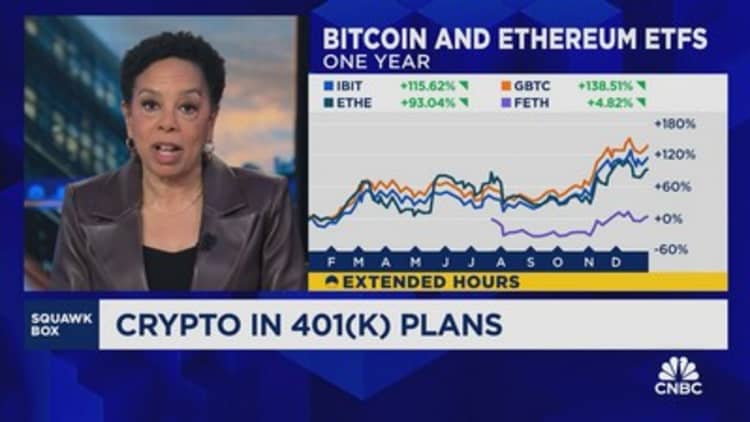
To understand the scale of this risk, consider the recent price action of Bitcoin. The chart below illustrates the sharp fluctuations that define the current crypto market environment.
While the asset price fluctuates, the amount you can contribute to a 401(k) remains fixed by IRS regulations. For the 2026 tax year, the standard contribution limit is $24,500. Participants aged 50 and older can add an extra $8,000 catch-up contribution, with those aged 60 to 63 eligible for an increased $11,250 catch-up if their plan permits.
These limits apply to the total contribution, regardless of whether the funds are invested in traditional stocks or crypto assets. Because you cannot contribute more than these caps, any allocation to volatile crypto assets directly reduces the amount available for more stable investments within the same account.

Compliance checklist for plan sponsors
Before adding cryptocurrency to a 401(k) plan, fiduciaries must navigate a complex regulatory environment. The Department of Labor (DOL) and the Government Accountability Office (GAO) emphasize that crypto assets carry unique risks that differ significantly from traditional equities or bonds. This checklist outlines the essential steps to ensure compliance with ERISA standards and protect plan participants.
Begin by formally documenting the investment thesis. Explain how crypto assets fit into the plan’s overall diversification strategy and risk tolerance. The DOL requires a clear written record demonstrating that the addition of crypto is prudent and in the exclusive interest of participants.
Evaluate the crypto provider’s security protocols, custody solutions, and regulatory compliance history. Verify that the provider can handle the unique technical risks of blockchain assets, including private key management and transaction finality. This step is critical for mitigating operational and cybersecurity risks.

Amend the Plan Document and Summary Plan Description (SPD) to explicitly include cryptocurrency as an available investment option. Ensure that the language clearly defines the risks, liquidity constraints, and valuation methods associated with these assets to avoid participant confusion or legal liability.

Develop clear, unbiased educational resources that explain the high volatility and speculative nature of crypto assets. Fiduciaries must ensure participants understand that these investments are optional and carry a higher risk of loss compared to traditional plan options like index funds.

Set up a regular review schedule to monitor the crypto investment option’s performance and the provider’s ongoing compliance. Fiduciary duties are continuous; periodic re-evaluation ensures that the investment remains appropriate as market conditions and regulations evolve.
Common questions about crypto in 401k 2026
Important: Always consult a qualified financial advisor or fiduciary before allocating retirement funds to volatile assets like cryptocurrency. The information above reflects current proposals and contribution limits, which may change based on final IRS and DOL regulations.
No comments yet. Be the first to share your thoughts!